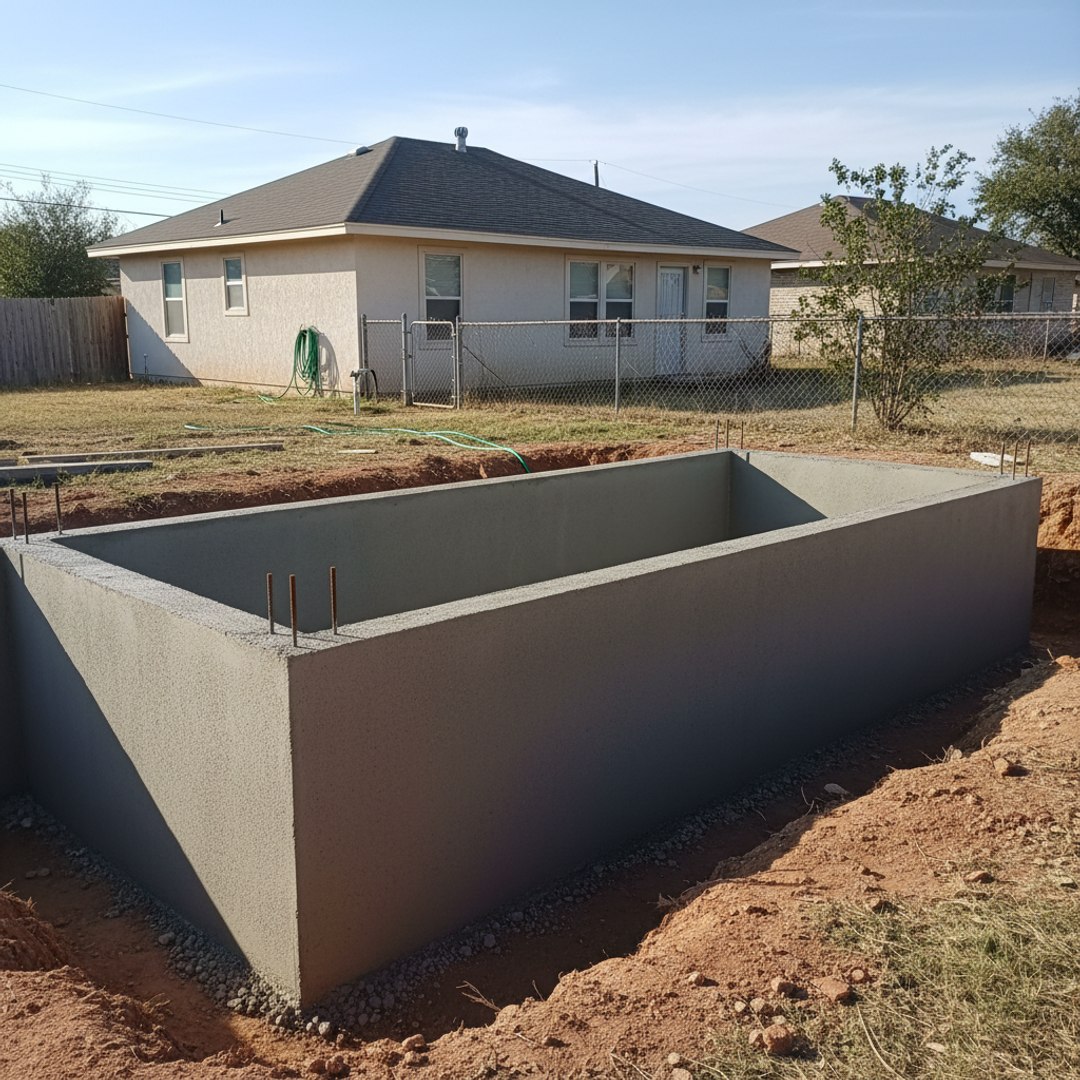
Everybody asks about price first. The question that actually determines whether your driveway or patio holds up for twenty years is simpler: when did you pour it. Concrete is a chemical reaction, not a material that just hardens like glue. Get the temperature and moisture wrong during the first 72 hours and no amount of good finishing work fixes it later.
Why Lubbock makes this harder than most places
We're on the South Plains at about 3,200 feet, which means bigger swings between day and night temperature than you get closer to sea level. We also get wind. Not a breeze, actual sustained wind, 15 to 25 mph on a normal day and gusting well past that in March and April. Wind pulls moisture out of fresh concrete fast, faster than almost anywhere else in Texas. That matters more than the thermometer does for a lot of pours here.
Summer: doable, but you're fighting the clock
July and August highs in Lubbock sit in the mid-90s, and the surface of a slab in direct sun runs hotter than the air temperature. Hot concrete sets fast. Too fast, and the crew is finishing one end of the slab while the other end is already going off, which leads to cold joints and trowel marks that never go away. Combine that heat with our wind and you get plastic shrinkage cracking, those thin surface cracks that show up within hours, not years. They're cosmetic most of the time, but they're avoidable. We can still pour in summer, we just do it early in the morning, use an evaporation retarder, and sometimes put up wind breaks around the perimeter so the surface doesn't flash dry before it's finished.
Winter: the freeze window is the real limit
Concrete needs to stay above 40°F for at least the first 48 hours or the hydration reaction basically stalls. If water in the mix freezes before the slab has gained enough strength, usually around 500 psi, ice crystals form inside the paste and the surface can scale or pop once it thaws. Lubbock's first hard freeze typically lands in early November and the last one can hang on into early April, with plenty of nights in the 20s in between. We don't rule out winter work, but it means blankets, sometimes heated enclosures, and a closer eye on the forecast than any other season. A slab poured on a 38-degree morning with a clear, cold night coming needs protection or it's compromised before it's a week old.
Spring and fall: the real sweet spot, with one catch each
The textbook ideal for pouring concrete is air and ground temperature between 50°F and 85°F, with low wind and moderate humidity. In Lubbock, that's mid-April through early June, and again mid-September through October. Fall is usually the calmer of the two. Spring brings our dust storms and dry line thunderstorms, which can roll in with almost no warning and dump an inch of rain on a slab that was troweled an hour earlier. If we're pouring in April or May we're watching radar as closely as we're watching the mix truck. September and October tend to give a longer stretch of workable, predictable days, which is why a lot of our driveway and patio work ends up scheduled then.
What the ground is doing underneath all of this
Weather isn't the only clock running. Lubbock soil is a mix of sandy loam over caliche, that chalky, cemented layer of calcium carbonate a foot or two down that doesn't compact or drain like regular soil. Where there's more clay mixed in, especially on older lots around North Overton and parts of the older grid east of University, the ground swells when it's wet and shrinks when it's dry. That movement is slow compared to the weather, but it's constant, and it's why the base prep under a slab matters as much as the pour date. A well-compacted base handles a wet spring and a bone-dry August without taking the slab with it. A shortcut on base prep shows up as cracking two years later, regardless of what month it was poured in.
How long before you can actually use it
Control joints get saw-cut within the first 24 hours, before the slab decides on its own where it wants to crack. Foot traffic is usually fine after 24 to 48 hours. You can drive a car on a new driveway after about 7 days. Full design strength, the number the structural numbers are based on, takes 28 days. That means an RV pad poured in late September is ready for the actual RV by late October, not the following weekend, no matter how solid it looks.
Permits and inspections don't run on a season
Inside Lubbock city limits, driveway approaches, sidewalks in the right-of-way, and any foundation work go through the city's permitting process, and that part of the schedule doesn't speed up or slow down with the weather. If you're outside the city limits in the county, or in one of the newer subdivisions with an HOA, like some of the developments out toward Cooper or Frenship ISD, there can be an extra layer of approval before a crew ever shows up with a mixer. Good to know that part of the timeline when you're trying to pin down a pour date, since it can take longer than the weather window you were planning around.
If you're trying to time a project for this year, the honest answer is late September through October gives you the fewest variables to fight. That's not the only time we pour, it's just the one that needs the least babysitting. For driveways, patios, foundations, or anything else listed on Premium Concrete Solutions, we'll tell you straight whether the date you have in mind is a good one or whether we should wait a few weeks.