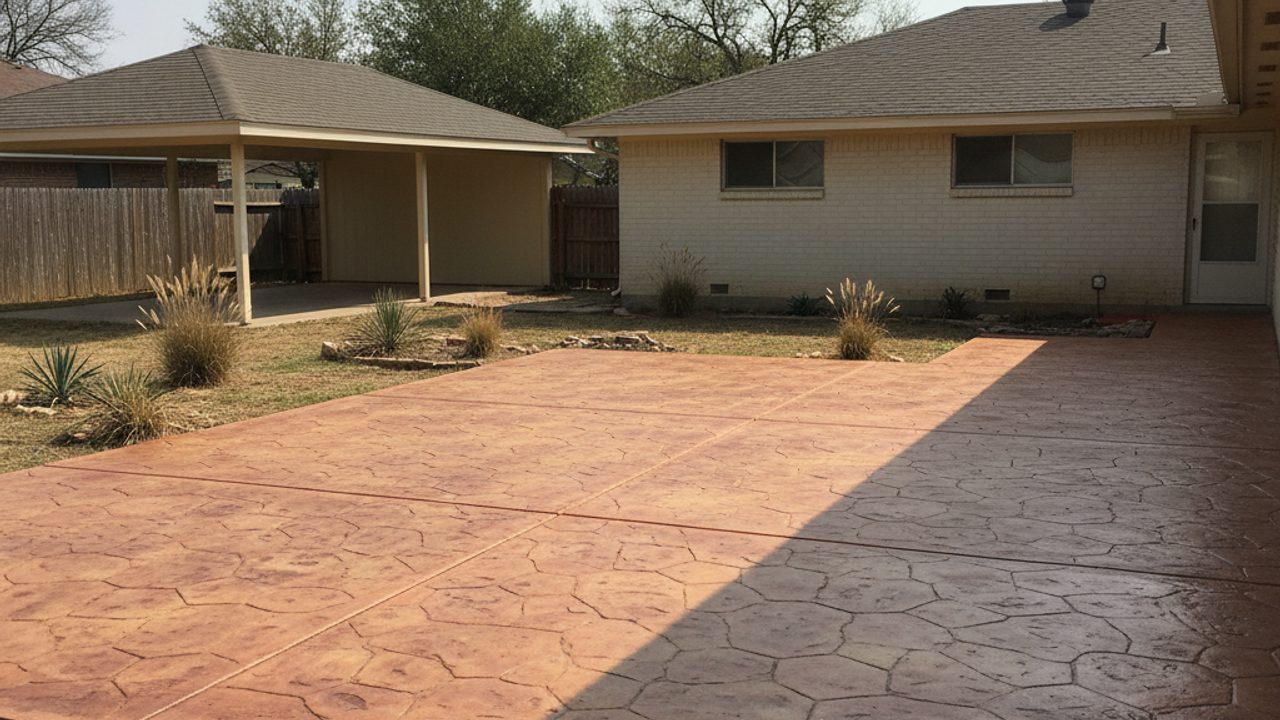
Concrete work looks simple from the curb. A form, a truck, a float, and a few days later you've got a driveway. What you can't see from the curb is the four inches of base rock under it, whether the rebar is tied or just laid in the mud, and whether the joints were cut before the slab decided to crack on its own. That's where a job goes right or wrong, and it's mostly invisible by the time you're writing the check. Here's what actually separates a contractor worth hiring from one you'll be calling back in two summers.
Texas doesn't license concrete contractors, so ask different questions
Texas has no statewide license for general contractors or concrete work. Anyone can call themselves a concrete contractor and pour your driveway tomorrow. That means the word "licensed" doesn't carry the weight here that it does in states that require it. What actually matters is general liability insurance, and you should ask to see the certificate, not just hear that they have one. Ask if they pull the permit themselves or expect you to. Ask how long they've been pouring concrete specifically in Lubbock, not just in construction generally, because the soil here punishes contractors who learned their trade somewhere else.
Workers' comp coverage for the crew is worth asking about too. If someone gets hurt on your property and there's no coverage, that liability can land on you as the homeowner. A legitimate outfit won't hesitate on this question. A guy working out of his truck bed might.
What Lubbock's ground does to a slab
Most of the South Plains sits on a layer of caliche, a hard, chalky calcium carbonate deposit that can start anywhere from a few inches to a couple feet down. It's tough to dig through, which is why some crews skip proper excavation and just pour on top of whatever's there. Caliche also doesn't drain well once it's disturbed and compacted wrong, so water sits under a slab instead of moving away from it. Parts of the county also have clay content that swells when it's wet and shrinks hard in a dry August, and Lubbock gets both extremes in the same year.
A contractor who knows the area will excavate to a real subgrade, compact it, and lay 4 to 6 inches of crushed base rock before any concrete goes down. Skipping that step doesn't show up at the walkthrough. It shows up eighteen months later as a driveway that's cracked along one edge because the ground under it moved and the slab had nothing stable to sit on.
What should actually be in the bid
A written bid should tell you the slab thickness. Sidewalks and patios are typically poured at 4 inches. A driveway that'll see a truck or an RV needs 5 to 6 inches, and if you're parking anything heavy, ask about it directly, because a driveway poured at patio thickness will spall and crack under the weight over time. Ask whether they're using rebar or wire mesh. Mesh is cheaper and fine for light-duty slabs, but rebar tied on chairs, lifted off the base rather than resting on the dirt, holds up better long term and is worth the extra cost on a driveway.
Control joints matter more than most homeowners realize. Concrete is going to crack somewhere, it's just a question of where. A joint spacing of roughly 2 to 3 times the slab thickness in feet is the standard rule, so a 4-inch slab should have joints cut every 8 to 10 feet. Those joints need to be cut within about 24 hours of the pour, before shrinkage cracking happens on its own in a random spot across your new driveway. If a bid doesn't mention joint layout at all, ask about it before you sign anything.
Curing time and why Lubbock's wind and heat change the math
Concrete doesn't dry, it cures, through a chemical reaction that needs water to keep going. In a Lubbock July, with low humidity and wind that doesn't quit, a slab can lose surface moisture fast enough to crack before it's even cured properly. A contractor who knows the climate here will either pour early in the morning during peak summer, use a curing compound sprayed on right after finishing, or keep it covered and misted for the first few days. If a crew pours at 1pm in August with 30 mph wind and no mention of curing method, that slab is at real risk of surface cracking, called crazing, within the first week.
As a rule, you can walk on a new slab in about 24 to 48 hours and drive on it after 7 days, though full strength takes closer to 28 days. Winters here bring somewhere around 30 to 40 nights a year below freezing, mostly December through February, so a pour scheduled too close to a hard freeze needs extra protection or it needs to wait. Any contractor telling you a freeze doesn't matter hasn't dealt with a slab that spalled because it froze before it cured.
Permits, older streets, and what's already in the ground
Most concrete work inside city limits needs a permit through the City of Lubbock, and driveway approaches or new sidewalks that touch the public right-of-way usually need sign-off too, since you're working next to a street the city maintains. Inspections typically happen at the footing or rebar stage, before the pour, so an inspector can see what's under the concrete instead of taking your word for it. If a contractor tells you permits are a waste of time or money, that's usually because they don't want an inspector looking at their base prep.
Older neighborhoods like Tech Terrace, Monterey, or the streets around Clapp Park were built in the 1940s through 60s, and the driveways and sidewalks out there are original in a lot of cases, poured over base prep standards from sixty years ago, with sewer and water lines a lot closer to the surface than in a newer subdivision. Digging in those yards means more care around unmarked lines. Newer additions in south and southwest Lubbock were often graded and leveled more aggressively before the first house went up, so the caliche is closer to the surface and the drainage patterns are different lot to lot. A contractor who's worked both kinds of streets will treat them differently instead of running the same playbook everywhere.
The red flags worth walking away from
- A bid that's thousands less than every other one you got, with no explanation for the gap.
- No mention of base rock, rebar or mesh, or joint spacing anywhere in writing.
- Cash only, no written contract, no permit discussion.
- Pressure to sign today because the price is only good for today.
- No local jobs they can point you to or drive you past.
None of this is complicated once you know what to ask. A homeowner who asks about base prep, joint spacing, and curing method on the first call is going to get a straighter answer, and a better job, than one who just asks for the lowest number. If you want someone to walk you through what a specific job on your lot actually needs, Premium Concrete Solutions is happy to talk through it before you commit to anything.